NCKU-Led Interdisciplinary Team Develops Cutting-Edge Targeted Protein Dephosphorylation Platform, Opening New Possibilities for Precision Treatment of Cancer and Neurodegenerative Diseases
Written & Image credit to Po-Han Chen.
The United States approved the world’s first proteolysis-targeting chimera (PROTAC) drug this year for the treatment of breast cancer, marking a major advance in cancer therapeutics. Building on this emerging technology, an interdisciplinary, inter-university research team involving Assistant Professor Po-Han Chen of National Cheng Kung University’s Department of Biochemistry and Molecular Biology has developed togoPhosTAC, a novel programmable targeted dephosphorylation platform that extends the concept of targeted protein degradation to targeted protein dephosphorylation.
In a mouse model of Alzheimer’s disease, the platform removed up to 90% of disease-associated phosphorylation from a pathogenic tau protein in the brain. This pioneering research has been published in the internationally renowned journal Nature Communications. TogoPhosTAC as a delivery-ready platform for targeted protein dephosphorylation
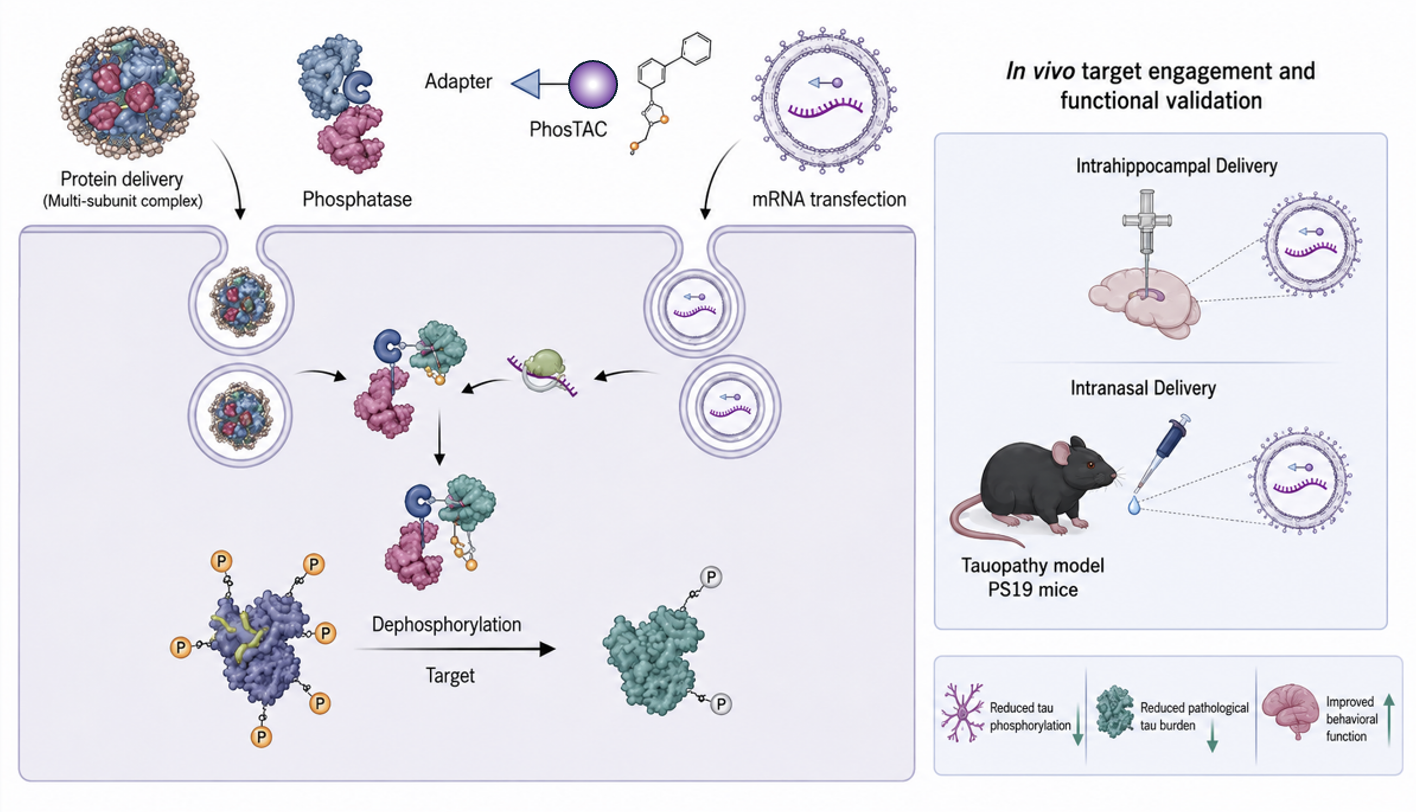
Assistant Professor Po-Han Chen’s team at NCKU’s Department of Biochemistry and Molecular Biology developed togoPhosTAC, a novel programmable targeted dephosphorylation platform.
Chen explained that protein phosphorylation is essential to cellular signaling and regulation. However, abnormal phosphorylation is closely associated with cancer, neurodegenerative disorders, and many other human diseases. Conventional drugs generally act upstream by inhibiting protein kinases or phosphatases, thereby indirectly altering the phosphorylation of downstream proteins.
In May this year, the U.S. Food and Drug Administration approved a PROTAC drug that uses induced-proximity technology to directly degrade and eliminate estrogen receptors in patients with breast cancer, introducing an entirely new therapeutic strategy. This revolutionary approach to degrade protein via induced proximity has attracted considerable attention throughout the global pharmaceutical industry, and numerous studies are currently underway. The three largest international biopharmaceutical licensing deals in recent years have all involved this emerging technology, with the largest valued at US$5.7 billion—underscoring its clinical potential. In Taiwan, both the Ministry of Economic Affairs and the National Science and Technology Council have provided funding to research teams working in this field.
Before returning to Taiwan, Chen conducted postdoctoral research in the laboratory of Professor Craig Crews at Yale University, where PROTAC technology was pioneered. Building on this experience and supported by research funding from the National Science and Technology Council and the National Health Research Institutes, Chen joined forces with Assistant Professor Yen-Chun Lee of NCKU’s Department of Chemistry, Associate Professor Chien-Hung Yu of NCKU’s Department of Biochemistry and Molecular Biology, and Assistant Professor Hong-Ru Chen of the Department of Life Sciences and Institute of Genome Sciences at National Yang Ming Chiao Tung University. Together, the researchers successfully extended targeted protein degradation into the realm of targeted protein dephosphorylation. Their newly developed programmable platform, togoPhosTAC, explores the potential of a new generation of bifunctional targeted therapeutics beyond PROTACs. The findings were published in the latest issue of Nature Communications, part of the Nature portfolio.
The pioneering research led by Assistant Professor Po-Han Chen’s team at NCKU’s Department of Biochemistry and Molecular Biology has been published in the prestigious journal Nature Communications.
According to Chen, togoPhosTAC integrates an engineered phosphatase, a bifunctional targeting molecule, and a novel delivery system. The approach effectively equips the phosphatase with a “navigation system,” directing it precisely to the intended destination to reduce phosphorylation of the target protein. Unlike PROTACs, which send an entire disease-associated protein to the cell’s degradation machinery for destruction, togoPhosTAC precisely guides a phosphatase capable of removing phosphate groups to a designated protein. This reduces disease-related abnormal phosphorylation while preserving the protein itself and resetting its functional state, thereby avoiding the complete loss of normal protein function that may result from degradation.
In animal experiments, the team selected tau, a protein closely associated with Alzheimer’s disease, as its validation target. Using togoPhosTAC, the researchers directed an engineered phosphatase to tau and administered the treatment intranasally, allowing it to enter the brains of mice with Alzheimer’s-like pathology. The results showed that the treatment reduced tau phosphorylation by up to 90%. Behavioral testing also indicated an improvement of more than 15% in treated mice. These promising findings suggest that togoPhosTAC could serve not only as a new research tool for investigating protein phosphorylation and cellular signaling, but also as a platform with potential applications in precision treatments for neurodegenerative diseases and in the development of drug-delivery systems targeting the central nervous system.
Chen noted that in an aging society, a significant proportion of older adults are affected by conditions such as Alzheimer’s and Parkinson’s diseases. These disorders are often characterized by the accumulation of particular proteins in the brain. Previous therapeutic efforts have included kinase inhibitors and antibody-based treatments, but their effectiveness has been limited. The team’s togoPhosTAC system could offer a new therapeutic option.
For certain cancers, conventional drugs typically inhibit upstream kinase activity and thereby indirectly alter the phosphorylation of downstream proteins. In the future, combining induced-proximity technology with the recruitment of phosphatases could substantially enhance therapeutic efficacy.
This inter-university and interdisciplinary study brought together expertise in chemical synthesis and molecular design, protein engineering, mRNA and drug delivery, neuroscience, and disease modeling. The team established a complete research pipeline extending from molecular design to validation in animal models, demonstrating the importance of interdisciplinary integration in pioneering biomedical research.
The collaboration has also made a direct contribution to the training of young researchers. Team member Yu-Yu Chen is a doctoral student in NCKU’s Department of Chemistry, while Dong-Ting Ke is a sixth-year student in NCKU’s School of Medicine. Coming from science and medical backgrounds, respectively, the two young researchers worked together to complete a study spanning chemistry, biomedicine, and disease treatment. Their achievement demonstrates the important role of interdisciplinary research in preparing the next generation of scientists.

An interdisciplinary, inter-university team involving Assistant Professor Po-Han Chen of NCKU’s Department of Biochemistry and Molecular Biology developed togoPhosTAC, a novel programmable targeted dephosphorylation platform. From left: Assistant Professor Hong-Ru Chen, Department of Life Sciences and Institute of Genome Sciences, National Yang Ming Chiao Tung University; NCKU Department of Chemistry doctoral student Yu-Yu Chen; Assistant Professor Po-Han Chen; NCKU medical student Dong-Ting Ke; and Assistant Professor Yen-Chun Lee, NCKU Department of Chemistry.
Chen emphasized that, in addition to establishing new therapeutic technologies, the team hopes to foster an interdisciplinary research environment that trains science doctoral students with biomedical and translational perspectives, as well as physician-scientists with strong foundations in basic research.
As precision medicine and innovative drug development continue to advance, the complex challenges posed by human diseases can rarely be addressed by any single discipline. Researchers who can understand the languages of different fields, cross disciplinary boundaries, and integrate diverse technologies will therefore become a vital force in the next generation of biomedical research.