Science for the Public Good: NCKU’s Hualien Science Workstation Builds a Compassionate Line of Defense in Guangfu
Written & Image credit to NCKU News Center.
Guangfu, Hualien, One Year After the Matai’an Creek Landslide-Dammed Lake Disaster: From Emergency Relief to Long-Term Partnership
As the first anniversary of the Matai’an Creek landslide-dammed lake breach disaster approaches, Guangfu Township—once severely impacted by mudflows and sediment deposits—remains on the path to recovery and reconstruction. One year after the disaster, National Cheng Kung University (NCKU) has launched a three-year Hualien Science Workstation to bring the university’s academic research capacity into the affected area. Covering farmland, forests, and communities, the workstation maintains ongoing dialogue with local residents and responds to real and urgent needs.
Turning Academic Depth into Solutions for the Real World.
President Meng-Ru Shen has advanced the university’s educational philosophy of “science for the public good” by expanding the power of interdisciplinary science and putting it into practice in post-disaster governance and local resilience.

NCKU’s Hualien Science Workstation team works in farmland, forests, and communities across Guangfu Township, integrating agriculture, water resources, public health, and medicine across disciplines while continuing to support local post-disaster recovery through scientific research.
Looking Back on the First Anniversary: From Post-Disaster Rescue to Long-Term Accompaniment
The significance of this initiative lies not in one-time assistance following a disaster, but in establishing a long-term presence and partnership. By integrating agriculture, water resources, public health, and medicine, the NCKU team transforms scientific research from knowledge confined to laboratories into knowledge and tools that local communities can understand, use, and continuously build upon—gradually strengthening their resilience in the face of future disasters.
As the first anniversary of the Matai’an disaster approached, CTS’s “News Summit” program contacted NCKU and produced a 52-minute special report. Thirteen minutes of the program, beginning at the 39-minute mark, covered the dedication and efforts of NCKU’s Guangfu Science Station. Through interdisciplinary scientific expertise, the NCKU team is building a compassionate line of defense for Guangfu Township.

President Meng-Ru Shen, guided by the school's philosophy of "using science to benefit society," has expanded interdisciplinary scientific capabilities and applied them to real-world disaster recovery and local resilience.
President Meng-Ru Shen, “Science for the Public Good”: Turning Academic Depth into Problem-Solving Power
One of the key elements of President Meng-Ru Shen’s educational philosophy is “science for the public good.” Its central spirit is to transform the university’s academic depth into knowledge capable of addressing real-world problems. The Hualien Science Workstation is a concrete realization of this philosophy in the post-disaster setting: research teams do not observe the affected area from a distance. Instead, they enter local communities, understand the needs of the land and its residents, and connect their research expertise with local experience to identify solutions that can be implemented.
From the physical and chemical properties of agricultural soils and their microbial communities, to soil mechanics and hydrological monitoring in landslide areas, and to post-disaster environmental and public health risks, NCKU integrates research capabilities from different disciplines into a scientific initiative focused on real-world problems. This also demonstrates the university’s social responsibility: responding to society through knowledge, accompanying communities through research, and making science an important force for protecting the land and its people.

NCKU team collaborated with the Hualien District Agricultural Research and Extension Station to assess whether the land was suitable for recultivation by starting with the microscopic physical and chemical properties of the soil and the microbial community, establishing scientific evidence through sampling and analysis, and then combining this with agricultural measures such as tillage and organic fertilizer application.
Reviving Farmland: Using Scientific Data to Help Damaged Soil Grow Hope Again
Following the Matai’an Creek disaster, large quantities of sediment covered farmland in Guangfu Township, seriously affecting the original farming environment in some areas. Working with the Hualien District Agricultural Research and Extension Station, the NCKU team began by examining the microscopic physical and chemical properties of soil and its microbial communities. Through sampling and analysis, the team established a scientific basis and, together with agricultural measures such as plowing and the application of organic fertilizers, assessed whether the land was suitable for resumed cultivation.
The research team also proposed using scientific indicators to help determine farmland conditions, converting different land characteristics into quantifiable and understandable information for subsequent cultivation decisions. Concrete results have already emerged in the field: with soil improvement and agricultural guidance, drought-tolerant corn with well-developed root systems was planted on damaged farmland. The plants grew into full and healthy stands, allowing farmers who had lost confidence in their land to see hope again.
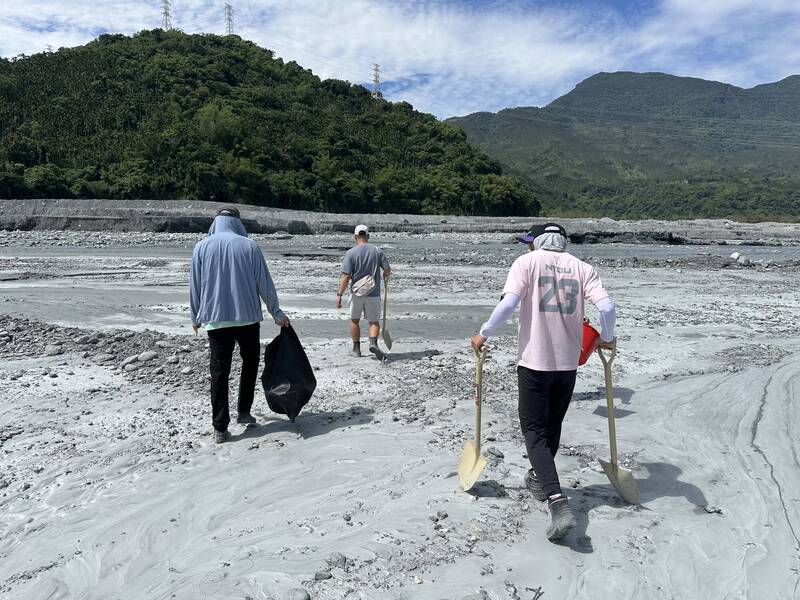
A research team from NCKU went deep into the Matai Anxi River and collected soil samples from the riverbed.
Protecting Forests and Rivers: Using More Than 100 Kilograms of Soil Samples to Understand Extreme-Rainfall Risks
Post-disaster recovery concerns more than farmland. The stability of forest and river systems is equally critical to local safety. In early April this year, the NCKU team entered the Matai’an landslide area and completed soil collection at more than 20 sampling points, gathering a total of over 100 kilograms of samples. The samples were brought back to the laboratory for mechanical testing to obtain key parameters required for numerical simulations, helping the team further understand how unstable soil masses might slide and block river channels during extreme rainfall.
Beyond scientific models, NCKU also places strong emphasis on the local knowledge accumulated by Indigenous communities and residents over many years. The team discussed flood-prone hotspots with local residents and planned to install hydrological sensing equipment so that monitoring information could be transmitted to local organizations, giving residents more time for early warning and emergency response. This collaborative model—combining “scientific data with local wisdom”—moves disaster prevention beyond a single engineering perspective toward more comprehensive local resilience governance.
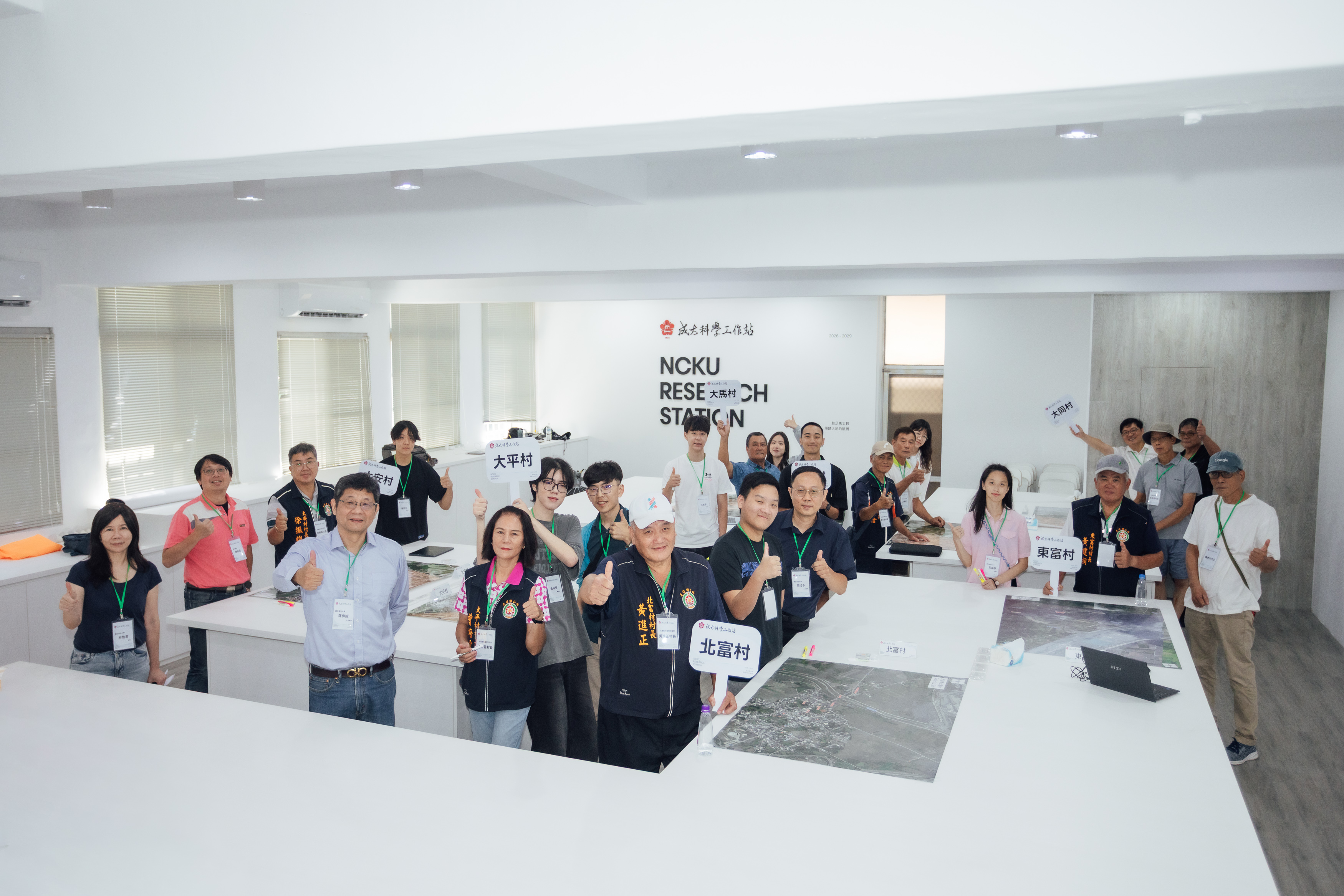
NCKU Hualien Science Station team went deep into the farmland, forests, and communities of Guangfu Township, integrating agriculture, water conservancy, public health, and medical care across disciplines to continuously support local post-disaster recovery through scientific research.
Public Health and Medicine: Continuously Monitoring Risks That Cannot Be Seen
After flooding, public health risks are often difficult to identify with the naked eye. NCKU’s medical team continues to visit settlements throughout Guangfu Township, placing mosquito larval traps at flood-prone hotspots and collecting environmental samples to track vector mosquito eggs and changes in water and soil conditions. At the same time, the medical team conducts sampling and analysis in areas that may have been contaminated, building a long-term monitoring database.
The team’s preliminary observations indicate that vector-borne disease risks remain controllable, while emphasizing the importance of continued monitoring. It is also monitoring pathogens such as Leptospira, which causes leptospirosis, and Burkholderia pseudomallei, which causes melioidosis—both of which may be associated with humid environments and animal activity. Through the accumulation of long-term data, NCKU hopes to establish an environmental safety database for the disaster-affected area, gradually shifting the public health defense from post-disaster emergency response toward scientific, long-term risk management.

National Cheng Kung University launched a three-year Hualien Science Workstation, bringing the university's academic research capabilities to the disaster area, from farmland and forests to communities, continuously engaging in dialogue with local communities and responding to real and urgent needs.
From “Rescue” to “Governance”: A Three-Year On-Site Presence for a Sustainable Post-Disaster Model
NCKU’s Hualien Science Workstation is planned as a three-year initiative. It represents not a short-term operation in which a team enters an area, completes its tasks, and leaves, but a sustained on-site presence focused on understanding local conditions. After entering Guangfu Township, the team established communication with residents and local organizations, began with actual local needs, and connected them with the university’s research capabilities so that scientific research could take root in the land.
This long-term presence also enables the university’s research mission to extend beyond knowledge production into social practice. In response to new forms of disasters brought about by climate change and extreme weather, NCKU is gradually accumulating scientific data and governance experience that local communities can use through interdisciplinary research, local collaboration, and continuous monitoring. The initiative aims to establish a sustainable post-disaster model and strengthen local disaster-prevention resilience.

One year after the landslide dam collapse in the Matai'an River in Hualien County, Guangfu Township, which suffered severe damage from mudslides and sediment deposits, is still on the road to recovery and reconstruction.
Learning Again After a Disaster: Making Science a Language for Dialogue with the Land
The first anniversary of the Matai’an Creek disaster is a time to look back on the scars, but also a moment to reconsider the relationship between people and nature. For NCKU, “science for the public good” does not simply mean providing technical assistance when a disaster occurs. It means developing a deeper understanding, through long-term research, of the relationships among rivers, land, forests, and communities—and transforming that understanding into more resilient action.
From farmland where corn is growing again, to soil brought back to the laboratory from the mountains, and to water bodies and disease vectors continuously monitored in communities, NCKU’s Hualien Science Workstation is using interdisciplinary scientific expertise to build a compassionate line of defense for Guangfu Township. President Meng-Ru Shen’s educational philosophy of “science for the public good” is also becoming concrete action on this once-damaged land: bringing the university into society, ensuring that research responds to needs, and working with local communities through knowledge and sustained companionship to seek possibilities for coexisting with nature for the next generation.