


Dedication to Medical Education: NCKU Professor Julia Yu-Yun Lee Receives 2026 MOE Award
Written by NCKU News Center Image by Professor Julia Yu-Yun Lee
“Serving at a medical center means not only taking on the mission of treating acute, severe, rare, and difficult illnesses, but also shouldering the responsibilities of teaching and research. Even more crucially, it requires passing down clinical experiences and specialized expertise. Only through this can we cultivate physicians to possess both clinical competence and humanistic care.” Upholding this guiding philosophy, Professor Julia Yu-Yun Lee of the Department of Dermatology, College of Medicine at National Cheng Kung University (NCKU), has continued to return to NCKU since her retirement six years ago in August 2020 to teach dermatopathology, impart her decades of clinical insight, and guide junior colleagues. Her recognition with the Ministry of Education’s “Contribution to Education Award” in 2026 stands as an authentic testament to her lifelong commitment to medical pedagogy.

Professor Julia Yu-Yun Lee “retiring without stopping,” continuing her lifelong devotion to medical education.
Regarding this honor, Professor Lee humbly stated that she is merely fulfilling her duties. She expressed her gratitude to NCKU for providing the platform to pass on specialized knowledge, research achievements, and clinical acumen, allowing her to continually contribute to medical education even into retirement.
To Professor Lee, the core value of medical education lies in taking thorough care of the patient. Holistic care and compassion represent the highest ideal of healthcare, and the starting point of clinical compassion is delivering an accurate diagnosis. Facing complex presentations, a physician must act like Sherlock Holmes—dissecting nuances layer by layer to reach a precise diagnosis and prescribe appropriate treatment. This approach mitigates physical and emotional burdens for patients and their families while avoiding unnecessary medical expenditures. The values and work ethic modeled by mentors in clinical settings subtly foster a profound sense of responsibility and rigor in trainees, driving a collective pursuit of academic excellence and quality care.
Professor Julia Yu-Yun Lee graduated from the School of Medicine at National Taiwan University (NTU). Following her dermatology residency, she went to the United States for advanced training, obtaining board certifications in Clinical and Anatomic Pathology as well as Dermatopathology, and served as an Assistant Professor of Pathology and Dermatology at the University of Pittsburgh.
In 1988, driven by a vision to advance medical care in southern Taiwan and pioneer dermatological training at NCKU, Professor Lee answered the call of Professor Kun-Yen Huang, the founding Dean of the NCKU College of Medicine. She returned to Taiwan to assist in establishing the Department of Dermatology at National Cheng Kung University Hospital (NCKUH), serving as its inaugural director. During her tenure, she also served as Director of the Department of Pathology, establishing Taiwan’s first formal dermatopathology training system and making significant contributions to the diagnosis and research of cutaneous diseases in Taiwan.
For Professor Lee, retirement did not mark the end of her educational mission. Embracing the spirit of “retiring without stopping,” she has dedicated herself to medical training, demonstrating a teacher’s enduring devotion to her profession, her students, and the medical vocation.
Professor Lee’s dual specialization in both Dermatology and Pathology, alongside her subspecialty in Dermatopathology, underpins her unique teaching perspective. In her view, dermatologists must not only observe superficial skin manifestations but also analyze histopathological alterations under the microscope, comprehend microscopic pathology, and evaluate whether clinical findings correlate with pathological changes—achieving “clinicopathologic concordance.” As there are numerous inflammatory disease and tumors can affect the skin or have skin manifestations, clinicopathologic correlation is crucial in dermatology; she has long advocated for the professional framework and subspecialty development of dermatopathology in Taiwan, consistently offering guidance and experience even throughout her retirement.

Professor Julia Yu-Yun Lee (back row, center) guiding young physicians Steve (back row, left) and Molly (far right) in histopathological slide reading. Her former student Betty (far left), currently a dermatopathologist in Germany, and pathologist Mark (back row, right) paid a special visit to their mentor.
Over the past six years of retirement, she has maintained a routine of mentoring residents every Monday and Thursday afternoon in dermatopathology slide review. Beginning with microscopic tissue morphology and correlating it with clinical presentations, she trains young physicians in keen observation, analytical reasoning, and precise diagnosis.
On Tuesday and Friday mornings, she conducts teaching outpatient clinics, demonstrating medical history taking techniques and the development of a “trained eye,” translating decades of clinical wisdom, medical humanities, and professional ethics into everyday practice.
Wednesday afternoons are dedicated to leading and participating in Clinical-Pathological Conferences (CPCs), clinical case conferences, and discharge case reviews. She models systematic clinical reasoning for complex cases, fostering effective communication and diagnostic integration between clinicians and pathologists. Furthermore, she serves as an advisor and mentor for young physicians' academic publications and research projects, instilling rigorous scientific standards.
Having served NCKU Medicine for 37 years, Professor Lee has trained over 60 specialists. She finds immense fulfillment in seeing dermatopathology thrive across successive generations. One of her accomplished proteges, Dr. Chao-Kai Hsu also has acquired international Dermatopathology certification and now is a Professor and the current Director of the Department of Dermatology at NCKU. He began studying dermatopathology slides with Professor Lee since his dermatology residency, and still continues to learn how to do in depth clinicopathological analysis with her and enjoy greatly the learning experience over couple decades.
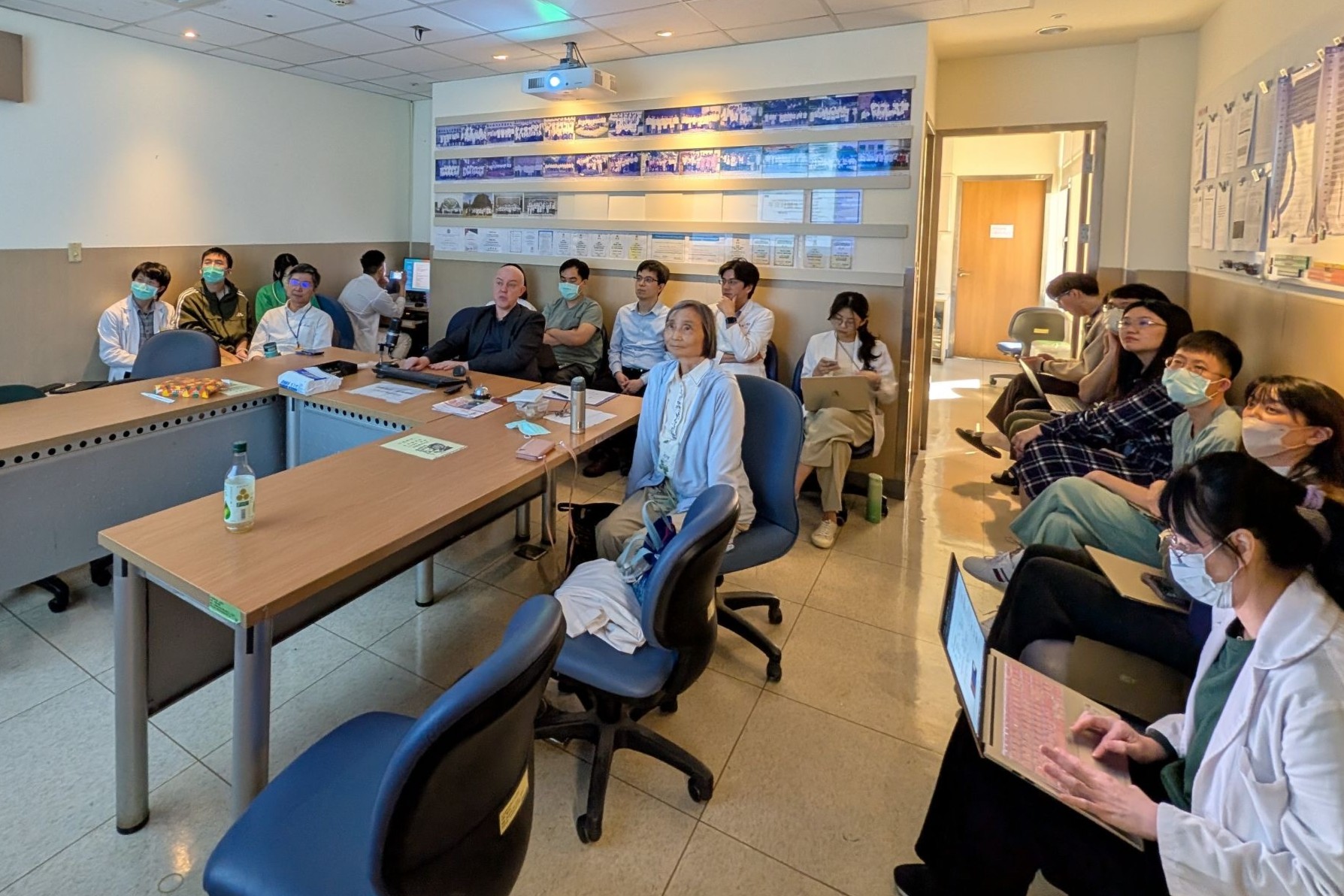
Professor Julia Yu-Yun Lee (center) presiding over the weekly Clinicopathological Conference, attentively listening to the case presentation.
In one memorable teaching encounter, a patient presented with inflamed subcutaneous nodules of the leg. Such lesions usually require pathologic study. Professor Lee’s clinical intuition and precise histopathological assessment of pancreatic panniculitis, followed by blood tests and imaging study to make the diagnosis pancreatic tumor within two weeks, prompting an immediate referral to pancreatic surgery for definitive intervention of a pancreatic cancer. This clinical experience impressed an observing PGY doctor [explanation: PGY doctor is postgraduate year training doctor] how a particular skin manifestation can serve as an important clue to an underlying internal systemic disease, thus strengthening her commitment to the specialty.
Professor Lee reflects that guiding young physicians and sharing clinical insights creates a symbiotic learning environment. The questions and feedback from trainees foster reciprocal growth: lifelong learning that remains intellectually stimulating and personally rewarding.
When advising junior physicians on career paths, Professor Lee suggests that beyond taking one’s interests, ability and skills into account, one should also consider workplace environments that would enable future growth. A supportive, collaborative setting allows clinicians to sustain growth throughout their careers. She also encourages trainees to avoid premature specialization, and recommends interdisciplinary exposure to broaden medical perspectives and cultivate integrated clinical reasoning.
Established by the Ministry of Education in 2006, the Contribution to Education Award honors individuals whose selfless dedication and perseverance advance education, revitalize educational resources, and preserve instructional wisdom. Professor Julia Yu-Yun Lee’s continuous service exemplifies this ethos. Receiving the 2026 Contribution to Education Award recognizes her personal achievements while highlighting the core values of medical education: passing on expertise, protecting patients, and empowering the next generation.