

NCKU President Michael Ming-Chiao Lai Hoped Relaxation of Academia-Industry Cooperation Regulations

Tainan, Taiwan, June 28th, 2010
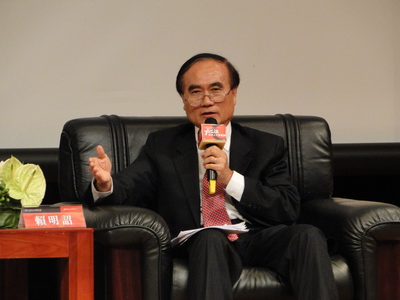
President Michael Ming-Chiao Lai of National Cheng Kung University (NCKU) was invited to attend the 2010 Asian Talent and Innovation Forum and engage in discussions, hosted by Chief Editor Ying-Chun Wu of Common Wealth Magazine, with President Susan Hockfield of Massachusetts Institute of Technology (MIT) and Chairman Bruce Cheng of Delta Electronics on June 28th in Howard International House, Taipei, Taiwan.
The vision and mission of the 2010 Asian Talent and Innovation Forum are to create a platform for dialogue among the world’s leading universities and companies, and Taiwan’s top decision makers on enhancing talent management and innovation cultivation.
NCKU President Michael Ming-Chiao Lai believed, “To create a win-win situation for academia-industry cooperation, the top priority is to relax government regulations, allowing schools to continue to participate in the research and development and product development of the industry. In addition, universities need to emphasize on the cultivation of talents and nurture future leaders.”
President Michael Ming-Chiao Lai said, “National Cheng Kung University is most noted for its engineering field. It is the so-called Massachusetts Institute of Technology in Taiwan. NCKU not only has excellent school traditions, it also has intimate relationship with the industry and outstanding alumni who have made major contributions. The alumni of NCKU have played a significant role in the development of Taiwan’s economy.”
President Lai also shared his 30 years of teaching experience and his thoughts on the differences between Taiwanese education and American education, “For example, an American professor came to Taiwan to be the judge of a rocket science competition and realized that the rocket technology created by Taiwanese students was excellent but the rockets all looked the same. The professor also gave speech in universities with higher ranking and universities with lower ranking and found out that the notes written by students from universities with higher ranking were better but nobody asked questions, whereas students from universities with lower ranking were more eager to ask questions. Taiwanese university students seem relaxed taking 20 credits. However, American university students are extremely busy taking only 12 credits. Apparently, the pressure of university students is too low and the pressure of high school students is too high, leading to conscientiousness in high school and ease in university. This is incorrect. Taiwan’s education still needs further improvement.”
President Lai mentioned, “Chairman Morris Chang of Taiwan Semiconductor Manufacturing Company Ltd. (TSMC) has once mentioned in a lecture, the educational goal of a top university is not to nurture talents but to cultivate top talents, in other words, leaders. Thus the current educational problem is that young men lack the characteristics of a leader.”
President Lai further explained, “According to the statistics, due to the rapid advancement of information and technology, on average, every individual needs to change 9 jobs in his or her life. This shows that young men today need to have abilities to adapt to the new field and new job to fit the job requirements. Students also need to cultivate self-learning ability in university to foster new abilities in the workplace. Future leaders need to have cross-disciplinary knowledge, international perspective, humane accomplishments and social caring, the direction of education at NCKU.”
Chairman Bruce Cheng of Delta Electronics also shared his experience of business management, “I encourage young men to think and be creative. For graduated students with engineering background, they need to have excellent engineering and mechanical knowledge when they enter workplace. However, the development of the enterprise needs to consider the issues of environmental protection and natural production products. The knowledge of the field of biology is what we lack the most.”
President Susan Hockfield of Massachusetts Institute of Technology, U.S., revealed, “In Massachusetts Institute of Technology, the patents of all the new inventions of professors belong to MIT. The premium is shared by both the inventors and MIT. The professors at MIT love to start business and establish companies. I feel proud that after these professors start their own business, they return to their alma mater to teach. Their first identity is scholar and their second identity is inventor. This is an excellent cycle at MIT.”
President Susan Hockfield also stated, “As an academic institution, Massachusetts Institute of Technology emphasizes on the quantity of academic papers, the teaching performance, and then the popularity of inventions. Because the main responsibility of a university is to pass down knowledge to the young generation, then provide service to the industry.”
President Michael Ming-Chiao Lai responded, “The most important missions of a university are research, teaching and service. Academia-industry cooperation is part of the service, but it should not affect the teaching and research of professors. Universities in Taiwan have devoted themselves to academia-industry cooperation. However, the concepts of professors on academia-industry cooperation are weaker. With many limitations on regulations, many professors cannot directly participate in the development of products or satisfy the needs of enterprises. Our top priority is to relax the government regulations.”
Chairman Bruce Cheng replied, “In addition to universities offering assistance, the research and development center of enterprises needs to make the right decision instead of relying entirely on schools. If schools can provide complete sets of products, they would become factories. Enterprises need to evaluate the inventions provided by schools, make sure they meet the requirements of the market and of intellectual property rights and have competitiveness.”
President Michael Ming-Chiao Lai of National Cheng Kung University (NCKU) was invited to attend the 2010 Asian Talent and Innovation Forum and engage in discussions, hosted by Chief Editor Ying-Chun Wu of Common Wealth Magazine, with President Susan Hockfield of Massachusetts Institute of Technology (MIT) and Chairman Bruce Cheng of Delta Electronics on June 28th in Howard International House, Taipei, Taiwan.
The vision and mission of the 2010 Asian Talent and Innovation Forum are to create a platform for dialogue among the world’s leading universities and companies, and Taiwan’s top decision makers on enhancing talent management and innovation cultivation.
NCKU President Michael Ming-Chiao Lai believed, “To create a win-win situation for academia-industry cooperation, the top priority is to relax government regulations, allowing schools to continue to participate in the research and development and product development of the industry. In addition, universities need to emphasize on the cultivation of talents and nurture future leaders.”
President Michael Ming-Chiao Lai said, “National Cheng Kung University is most noted for its engineering field. It is the so-called Massachusetts Institute of Technology in Taiwan. NCKU not only has excellent school traditions, it also has intimate relationship with the industry and outstanding alumni who have made major contributions. The alumni of NCKU have played a significant role in the development of Taiwan’s economy.”
President Lai also shared his 30 years of teaching experience and his thoughts on the differences between Taiwanese education and American education, “For example, an American professor came to Taiwan to be the judge of a rocket science competition and realized that the rocket technology created by Taiwanese students was excellent but the rockets all looked the same. The professor also gave speech in universities with higher ranking and universities with lower ranking and found out that the notes written by students from universities with higher ranking were better but nobody asked questions, whereas students from universities with lower ranking were more eager to ask questions. Taiwanese university students seem relaxed taking 20 credits. However, American university students are extremely busy taking only 12 credits. Apparently, the pressure of university students is too low and the pressure of high school students is too high, leading to conscientiousness in high school and ease in university. This is incorrect. Taiwan’s education still needs further improvement.”
President Lai mentioned, “Chairman Morris Chang of Taiwan Semiconductor Manufacturing Company Ltd. (TSMC) has once mentioned in a lecture, the educational goal of a top university is not to nurture talents but to cultivate top talents, in other words, leaders. Thus the current educational problem is that young men lack the characteristics of a leader.”
President Lai further explained, “According to the statistics, due to the rapid advancement of information and technology, on average, every individual needs to change 9 jobs in his or her life. This shows that young men today need to have abilities to adapt to the new field and new job to fit the job requirements. Students also need to cultivate self-learning ability in university to foster new abilities in the workplace. Future leaders need to have cross-disciplinary knowledge, international perspective, humane accomplishments and social caring, the direction of education at NCKU.”
Chairman Bruce Cheng of Delta Electronics also shared his experience of business management, “I encourage young men to think and be creative. For graduated students with engineering background, they need to have excellent engineering and mechanical knowledge when they enter workplace. However, the development of the enterprise needs to consider the issues of environmental protection and natural production products. The knowledge of the field of biology is what we lack the most.”
President Susan Hockfield of Massachusetts Institute of Technology, U.S., revealed, “In Massachusetts Institute of Technology, the patents of all the new inventions of professors belong to MIT. The premium is shared by both the inventors and MIT. The professors at MIT love to start business and establish companies. I feel proud that after these professors start their own business, they return to their alma mater to teach. Their first identity is scholar and their second identity is inventor. This is an excellent cycle at MIT.”
President Susan Hockfield also stated, “As an academic institution, Massachusetts Institute of Technology emphasizes on the quantity of academic papers, the teaching performance, and then the popularity of inventions. Because the main responsibility of a university is to pass down knowledge to the young generation, then provide service to the industry.”
President Michael Ming-Chiao Lai responded, “The most important missions of a university are research, teaching and service. Academia-industry cooperation is part of the service, but it should not affect the teaching and research of professors. Universities in Taiwan have devoted themselves to academia-industry cooperation. However, the concepts of professors on academia-industry cooperation are weaker. With many limitations on regulations, many professors cannot directly participate in the development of products or satisfy the needs of enterprises. Our top priority is to relax the government regulations.”
Chairman Bruce Cheng replied, “In addition to universities offering assistance, the research and development center of enterprises needs to make the right decision instead of relying entirely on schools. If schools can provide complete sets of products, they would become factories. Enterprises need to evaluate the inventions provided by schools, make sure they meet the requirements of the market and of intellectual property rights and have competitiveness.”
Provider:
新聞中心
Date:
99-07-05